Sunday, October 16, 2016

Fresh, or canned? Still good: Roasted red pepper soup


Ciao, ragazzi.  Today, we are going to begin prepping ourselves for the winter, by making a soup from mostly fresh ingredients, but also by being mindful that it will be winter soon, and that is no excuse for not making a delicious meal.

Let Annalena explain:  in general, she frowns upon using canned goods, unless the good in question is one that is not available to her in good quality, or just is not available, period.  A very good example of this, is coconut milk.  Annalena CAN make coconut milk, but....  it would not be pretty. 

A better example for most of us, is canned tomatoes.  For that period of time that always seems too brief  and when fresh tomatoes that are local, smell like sun, and are reasonable in price, we must ALL use them. That window, however, is always short. So, you should have canned tomatoes on hand, ALWAYS.  You will see all kinds of reviews as to which brand is the best. Annalena says you should use what you like.  She did that here. 
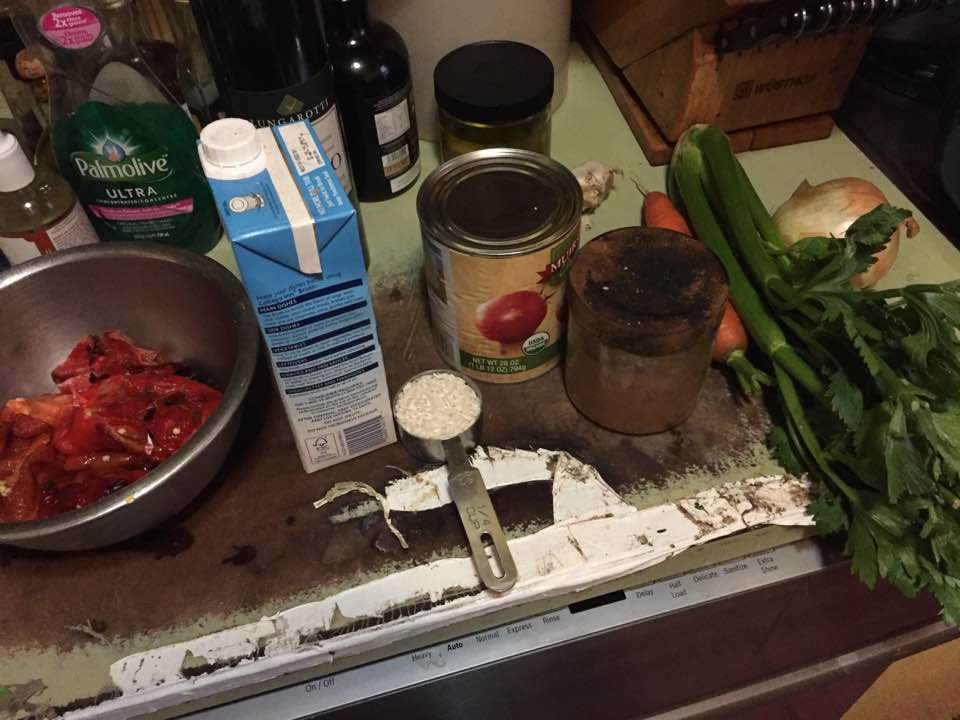


What you see below you, are the ingredients for this soup:  on the far left, are four roasted red peppers.  Then a quart of stock, 1/4 cup of Italian rice, a 28 ounce can of chopped tomatoes, cinnamon (yes, cinnamon.  We won't use a lot but we will use it), and the "holy trinity" of soup making:  carrot, celery and onion. 

Annalena had a lot of beautiful fresh red peppers available to her.  If you do not, get jars of the roasted ones.  When you buy these, shop CAREFULLY.  The roasted flavor is important here, and not all jarred peppers are roasted. Most of the Italian brands are.  In fact, if you look through the glass of the jar, you may see some char marks.  Buy those.  You need four peppers for this dish, and a jar of roasted peppers rarely has more than 2.  Do the math.  And if you have more than you need, use them in the soup.

If you are fortunate enough to have fresh ones, turn your oven to the broil mark, put your peppers on a baking sheet, and get them as close to the heat source as you can, without touching it.  Adjust your oven racks if you must.  It's not hard.  After 5 minutes, check.  If the peppers have blackened, rotate them.  And so on, and so forth, until the entire pepper is black.  Carefully move them to a bowl, and now cover them, so they steam cool.  When they're cool enough to handle, the blackened skin will come right off. 


Yes, this is tedious.   But there's no work involved, and in the interim, you can get to work on your other vegetables:

What you have here is a large carrot, chopped, and two stalks of celery, also chopped. You do not see the large yellow onion, but chop one of those too, and don't worry about surgical precision. You also don't see four garlic cloves, which you will peel, and chop.  Now, add two tablespoons of olive oil to a big soup  pot, and add the onion, carrot and celery.  Cook these, for about five minutes, stirring as you go:

 Now, we're getting there!  Here's where you open up the tomatoes, and pour them in.   Add about 1/4 teaspoon of cinnamon  (don't omit it, and use a small amount.  You'll notice it).  Reduce your heat to medium, and let this bubble for about ten minutes:

 Just about home, kids.  After the ten minutes, add your peppers, cut up roughly, the basil, a quart and a half of stock of some kind.  Annalena used chicken diluted with water.  Use vegetable if you like.  Taste a bit of this.  You'll want salt and pepper.  Also, if you have some fresh basil, add a couple sprigs.  And add that rice.  

Let this all cook away for twenty minutes or so, and check to see if it's "done" by tasting a rice grain to check.

Annalena almost stopped here. She didn't.  She got this recipe from Martha Rose Schulman's column, and the notes to the recipe were very clear, that pureeing it, added flavor.  Dubious of this, Annalena tried a small bowl at this point, and then afterwards.  The pureeing IS a good idea. So let the soup cool,  and then puree it in small batches:
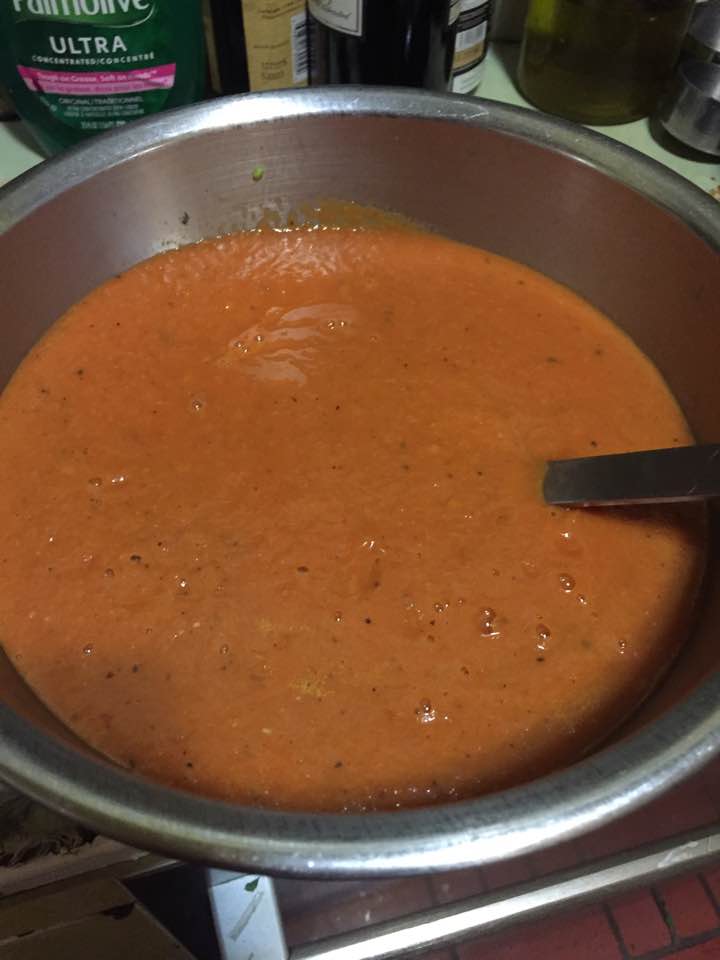
Look at that color!  Can you stand it?  You won't taste rice grains, but you do have a nice thick soup, that is.... GLUTEN FREE.  If you used vegetable stock, it's.... VEGETARIAN..  And, it's... VEGAN.

So, there you have it.  A soup that can be made from what's fresh, or from what's in jars and cans.  What could be bad about that?  Make yourself some grilled cheese sandwiches, (unless you're a vegan), and you've got dinner.

Back soon, ragazzi, with a Venetian soup for cabbage, the vegetable of the moment in Annalena's home.

Sunday, October 9, 2016

Autumn calling: we answer with a gratin of cabbage, cheese, onion and wild rice


Well, ragazzi, facts are facts.  And the facts are, the temperature is not moving out of the low 70s during the day, the nights are in the 50s, Annalena has pulled out her sweatshirts:  we are in that period that Annalena thinks of as "Sumtumn" or "Autmer," something like that.  It's sort of a cross of summer and autumn.  We say goodbye to some of the pure summer things for another year:  the vendors no longer have peaches or nectarines, the basil is nearly gone, the tomatoes "ain't what they used to be," and the annual onslaught of winter squash, cold weather greens, and:  cruciferous vegetables has begun.

Every year, Annalena and the Guyman look forward to the arrival of these colder weather vegetables, knowing full well that at some point, they are going to be thinking:  "Kale AGAIN?'  Such is the tradeback of living and eating seasonally ragazzi.

And let us be honest with each other:  many of these vegetables require a lot more love than the tomato you can just slice and put on a table with some salt, or the peach that just sits there, dripping juice.  So we take solace in the fact that the kitchen might not be as hot as it was, and get set to do some serious work.

"Serious work," however, need not be heavy work, and what after all is the point of doing this, if you're not going to enjoy the result?  Annalena turns to one of her favorites, Martha Rose Schulman, for the recipe which follows.  Yes, you will spend some time in the kitchen, but you will be pleased at the results.  And all you vegetarians will love this.  So, too, will those of you who want something a little lighter, and a little healthier.  So,  "cominciamo."

Let's start with the cabbage:  if you walk through your farmers market, you will be astounded at the varieties you can find nowadays. When Annalena was just a bambino, there were red cabbage heads (smaller), and plain white cabbage heads, the size of giant boulders.  This week at her market, there was spitzkohl, red spitzkohl, two or three kinds of white cabbage, and her favorite:  savoy.  This is the crinkly one.  You've seen it.  Cabbage does not, inherently, have much flavor,  but savoy seems to have more of it.  You are going to need a healthy 1.5 pounds of it.    In the picture below, the half on the left, is 1.5 pounds.  Keep this in mind, because you will almost never find a cabbage weighing 1.5 pounds.  Look for a second recipe (Annalena has posted them), or make coleslaw:

Next you will need 2 cups of grain, already cooked.  Ms. Schulman calls for millet.  

Do you know what millet is?  If you have ever had a pet bird, and you bought the bird a strand of seeds to nibble on, that's millet:


Annalena loves millet, but she had none in the house.  She did have wild rice, so she cooked that.  Use what you have.  Brown rice seems right with this dish, but couscous would work, too.    Keep the cooked, cooled grain to the side for now. We'll come back to it. 

Using a sharp knife, shred your cabbage.  You'll have a lot of it:

Trust Annalena:  it ain't all that.  Cabbage is filled with water and, as you will see, this will shrink

Ok, so now you need to set your oven to 375 and you also need to slice up and dice up a large onion.   You should also chop up a healthy half cup of fresh dill. (you can leave out the dill, if you don't care for it)


 Get the onion into a big pan with a tablespoon of olive oil, and cook it slowly:  about ten minutes:

While this cabbage is cooking, combine a cup of low fat cottage cheese (in this VERY rare case, ragazzi, the low fat version is better.), together with 2 large eggs.  If you happen to have a food processor, swirl it through to make it smooth.  If you are so inclined, you might want to add some lemon peel, or other flavorings here. And if you don't have cottage cheese, use ricotta, or any of the softer cheeses that are not so fat rich.  Mascarpone, for example, is not going to work.  You CAN add more flavor it you like, by adding grated parmesan, or cheddar, or something like that.  Do keep in mind that your cheese is a binder here, so that should guide your choices. 
So we have our chopped cabbage, our cooked onion, our cheese "custard," and now the fun stuff begins. 

Dump the cabbage into the pan with the onion:

Can you see how pale that cabbage is, and how it's crowding the pan?  If you wait, patiently, for about 3 minutes:

And then after about ten:


Not much there, huh?  Can you see the onions mixed with the cabbage?  Those little brown spots. 

At this point, you should taste the cabbage and use your salt and pepper.  Be generous.  Time to combine the cheese mixture, the dill, and the grains, off the heat and stir it together:


After you've stirred it together, fill up a non metallic baking dish:


This goes into the oven for 40 minutes.  The sugars in the cabbage will emerge, and so too with the sugars in the cheese.  And: 


Annalena has a fair number of vegetarian readers, and she can tell you that she would serve this to you, proudly, any day.  So, how about you do it yourself, and serve it to yourself?  It's the time to cook these things, ragazzi, so give it a try. Annalena is right there with you.

Easy, delightful, and yummy: Citrus chicken breasts.


Ciao, ragazzi.  Readers will have noticed that Annalena and the Guyman eat a fair amount of chicken, usually on the bone, and usually legs and thighs.  We DO eat the classic boneless, skinless chicken breasts, but Annalena usually saves those dishes for quick lunches on the weekends, when she wants to make some high protein, relatively healthy (emphasis on the "relatively" here ragazzi), and not too challenging to make.  

Well, sometimes she wants to do that for dinner.  When she saw this recipe, she thought immediately that it was a perfect supper dinner. And it is.  You can make this for yourself, BUT, in Annalena's view, there are parts of it that make it suitable for informal company as well.  If you're not comfortable in the kitchen, this is also a VERY good place to start gaining experience.  Let's begin.  And we begin by thanking Mark Bittman for the recipe.

First, let's see our ingredients:


What you see there are all of them:  two large, boneless, skinless chicken breasts, a couple of limes, a large orange, a couple of tablespoons of butter, and some olive oil.  We also have, of course, the ubiquitous salt and pepper.  Now, here we go.  And this goes fast.  So, ATTENZIONE!

First, cut the orange in half, in the middle (as if you were making half grapefruits).  Do the same thing for one of the limes.  Squeeze the juice out of one half of the orange, and the lime:

The next thing you do, is pour a quarter cup of flour onto a plate.  Spread it out, and add some salt and pepper.  Then, put the butter and olive oil in a pan - two tablespoons of each, and your butter is unsalted.   Heat this at a medium high flame, until the butter is melted and bubbling:

While this is happening, quickly "dredge" the chicken breasts in the seasoned flour.  By "dredging" , all you're trying to do is cover each side, completely, with the flour.  Once you have that done, drop them into the cooking fat, and lower your heat to medium:

You're going to be cooking these for five minutes on a side.  And while they're cooking, slice the peel off the remaining half of the orange, and cut the segments apart.  If you put the cut side down on a counter, you will see EXACTLY where to cut.  And as is frequently the case, surgical precision is not the goal here. 

After ten minutes of cooking, your chicken is going to look something like this, and you're going to have a bit of fairly brown "stuff" in the pan.  

This is a good thing.  Take those cooked chicken breasts out of the pan, put them on a plate and cover, while you finish this off. 

Remember that juice you expressed from the fruit?  Well, you add it to this stuff at the top, again at medium high heat, and swirl it around for about 2 minutes.   Then, you add those orange segments you prepared while the chicken was cooking, and you add them to the reduced juice, for all of about a minute. 


Finally, just put the cooked chicken back in the pan, turn it to cover it with sauce, and ... VOILA:


So you're thinking  "what about that second lime?" AH, you can go several ways. First, you don't have to use it at all.  Following the recipe to a "T", you slice it and add it as garnish. Annalena squeezed the juice into her sauce.  (Of course, you COULD make margaritas. )
Now if that is not a perfect dish for a busy night, Annalena thinks you need to quit your job.  So, give it a try ragazzi.  This one seems to be absolutely seasonally independent, but as fruit gets scarce, and we're all trying to up our vitamin C... here it is. 

If you try no other recipes from this blog, ragazzi, PLEASE  try this one.  You will be very glad you did, and you will have something very easy and tasty in your repertoire. 

Sunday, October 2, 2016

Sort of Sicilian, sort of Greek, sort of American: Chicken and cauliflower stew


https://www.youtube.com/watch?v=X8HMzPOaB10


Ciao ragazzi e buon giorno!.  And, if appropriate, HAPPY NEW YEAR!  Annalena welcomes all of you back to this wonderful, "perfect at just about any time of the year" recipe.  It is a dish which was described as "Greek," although it isn't, tasted Sicilian to Annalena, although it isn't, and is irresolutely American.  It's good, too, and you might even get a veggie hater to like cauliflower. And for Annalena's music fans, a video above relates to what happens in the recipe further on

On the "nationality" of the dish:  you HAVE noticed, haven't you (since Annalena essentially drives this spike into your eye, over and over again), that if there are certain ingredients in a dish, it almost always gets a geography attached to it.  This one is supposed to have oregano, black olives and feta cheese in it - which makes it.... GREEK!    Now, Annalena showed the recipe to her secretary, from Athens, who said  "PHEH.  There is nothing Greek about that dish but the name."    There are components of it which made Annalena think:  SICILY.  Except you won't find much in the way of chicken recipes in Sicilian cookbooks.  No, ragazzi, this one is resolutely American.  It is also resolutely good.  While we're in for a bit of time in the kitchen (maybe 90 minutes), we're getting a REAL GOOD supper dish that you will appreciate. And for that, Annalena gives an all American YEE HA.

So, let's get started. You need 8 pieces of dark meat chicken:  that means thighs and legs, amici, on the bone.  You can remove the skin, or not, as you please (Annalena pleases to leave the skin on):

You see in this picture, just about all of the ingredients you will need.  At the left is Annalena's jar of cinnamon - yes cinnamon.  Don't leave it out.  It WILL make a difference.  You will also see that Annalena has 6 whole legs of chicken.  That is because that is what her big skillet can handle.  If you have a pan that can hold more, make more: this dish is not sensitive to the amount of protein.    

So, we get started with prepwork:  salt those chicken legs, dice the onion (a big red one), and sliver 4 cloves of garlic (you can go low on this one, but why would you?)  Pour out a tablespoon of oil in your skillet,  and if you are so inclined (Annalena is not), pulse the contents of that can of tomatoes in a food processor .  You also see black olives in the upper right hand corner.  If you use them, use good ones, and, depending on who's eating, pit them or not.  You need about 20.   

You see that cauliflower on the right?  Annalena's favorite yellow .  Now, you break this into florets, and slice them thick:

And now, we cook.  Remember that tabelspoon of olive oil?  Heat it, and get as many pieces of chicken in the pan as you can. It will seem like insufficient oil.  It's not.  The legs of chicken contain a nice amount of fat, and you may very well have more at the end than when you began.  Sear the legs, on both sides, for 4-5 minutes, until you get really nice color:

When you're done, pour off that fat.  You really need to, because it has been, ahem  "used."  You will have a bit of fond in the bottom of your pan:

You want this.  So what you do is have two tablespoons of red vinegar at the ready and pour that into the hot pan, moving your face away, because the vinegar will evaporate , and it's not pleasant.  Scrape a bit as it does, and then add a second tablespoon of olive oil.   Add your chopped onion to this, together with salt and pepper.  Use a fairly high flame, keep the onions moving, and after five minutes you have:

Now, you cover that pan and lower the heat as far as it will go.  You come back in ten minutes:

See the difference?  Yes, Esther Philips sang of 'what a difference a day makes."  In the kitchen,  it can be ten minutes. 

Add your sliced up garlic, and cook it for a minute.  Now, add the can of tomatoes, put through the food processor not,  a healthy half teaspoon of cinnamon, and then a big tablespoon of chopped thyme, chopped oregano, or choppped marjoram.  (That's what Annalena had).  If you don't have fresh, why not?  If you are using dried, cut the quantities in half.   This is all going to simmer, covered for ten minutes:

Take a look at that color.  It won't stay.  After ten minutes,  uncover the pot, nestle the chicken in, cover it again, and cook for 20 minutes:

See how we've gone from red to a sort of burnt orange?  That's cooking, kids.    Now, take those slices of cauliflower, and the olives, and add them:

You cook this for another twenty minutes.    At the end of that, if you are so moved, stir in some chopped parsley, and perhaps some feta cheese (Annalena declined on both:  she had no parsley, and she was using cheese in her salad).   

This truly calls for something like rice, or noodles, or spatzle, or whatever your absorbing starch of choice is.  The chicken will be ridiculously tender, the veggies toothsome, and that little bit of cinnamon will keep you wondering :  "what is that? " and perhaps feeling a bit of exotica in your food.  We can all use that, ragazzi, can't we? 

Sunday, September 25, 2016

Don't follow the rules: roast chicken with figs


This one, ragazzi, is about how you can play with recipes and get a good dish - maybe even a new one.  You don't have to pretend each recipe is holy scripture - or maybe you should, because none of us are literalists, are we?

Last week, Annalena was sort of in a haze one night as she was planning dinner for the next night.  "The best laid plans" do go astray, Annalena couldn't get to her market, so she needed to improvise.  Well, she had some chicken, and she remembered reading a recipe for chicken roasted with figs.  She found the recipe, but she did not have all the ingredients on hand, and the recipe called for an overnight marinade.

Know what?  You can do this without the marinade.  Also, the recipe called for black mission figs.  When Annalena got to her fruit vendor (she always buys figs from a street vendor), he had green figs, no black ones.

Know what?  The recipe works with green figs.  Finally, she had no fresh rosemary.

You guessed it:  it works with dried rosemary.  And here's how it goes.

First, you turn your oven to 450.  While that is happening, take four complete chicken legs (drumstick and thigh), and salt and pepper them well. Then, you combine them with 2 tablespoons of olive oil, a little grated peel, about a tablespoon of rosemary needles - fresh if you have it, dry if you don't.  Put that in a bowl, and let it sit for about an hour (if you can, less if you can't).

Get half a pound of figs, and get the stem off of each one, then quarter them.  Now, in calling for the black figs, the recipe is thinking of a jammy, almost sweet and sour sauce for the chicken, and that would have been delightful.  Black figs cook down faster than the green ones do.  By using the green ones, Annalena produced a chunkier, more solid dish.  Your call.

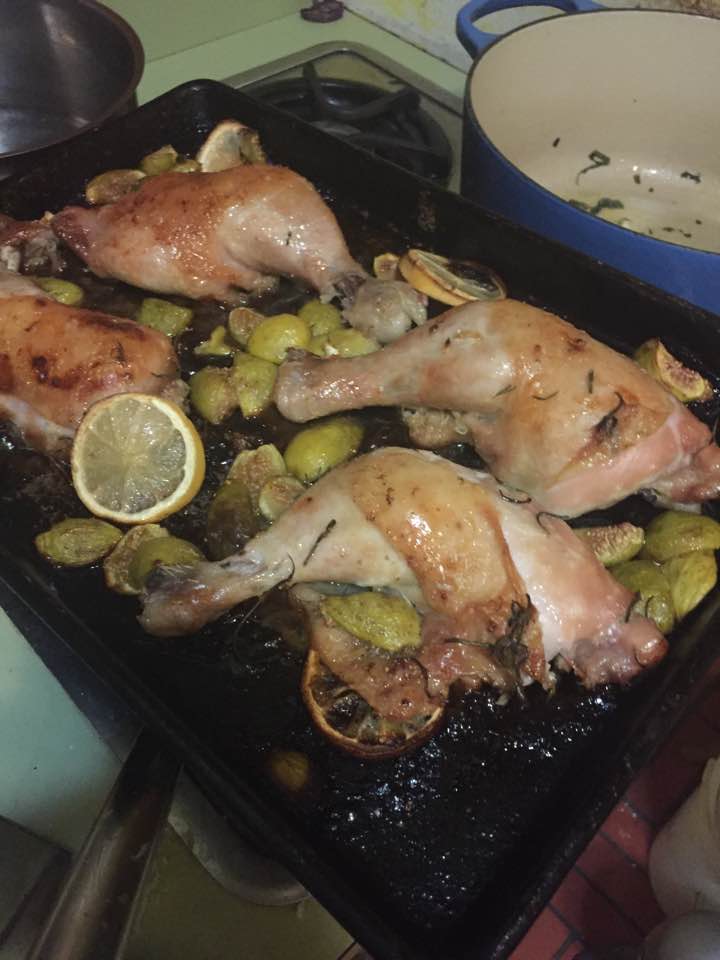
So what you do is you lay the chicken that has marinaded, for however long, on a baking sheet.  There will be space, and you add the figs. Finally, if you like roasted lemon (which Annalena does), you add slices of lemon:


Get this into your oven .  We're going to roast this for about 40 minutes total.  After twenty minutes:


Rotate the chicken.  See, every restaurant, like everyone of us, has "hot spots," and you want to even things out.  So after the rotation, let the thing cook for another twenty minutes (Incidentally, ragazzi, try to do this quickly, because you'd be stunned how rapidly the temperature of an oven drops with an opened door). 

And after that final 20 minutes:

Some of you prefer  your chicken to have darker, crispier  skin.  To do that here,  take the tray out of the oven, move the temperature to the broiler setting, and put the chicken back in for a couple of minutes.  These are legs, which have much more "juice" and fat than breasts, so they can take the heat.  Check after two minutes, and if you've got what you want, you're done.  Your lemons will crisp up, and the sugar in the figs will carmelize.  None of that is a bad thing.  

Then you serve it forth.  


Figs are a fruit that does not travel well, ragazzi, so if you DO eat fruit out of season, understand that you will not find fresh figs after late autumn.  So, as the commercial used to say  DO IT NOW!!!

And that's it for this weekend kids.  Watch the debates, register to vote if you didn't, and remember what's at stake.  It's more than dinner

Unexpected, with the versatile eggplant: Eggplant soup


It always surprises Annalena that there is such a disparity of opinion on eggplant.  There are people - Annalena knows several- who HATE it.  Now, this is something that she truly doesn't understand.  She respects it, but unlike other vegetables, or fruits, or anything else, where she can see (while disagreeing) HOW a dislike can develop, EGGPLANT????  She doesn't understand it.  Not at all.  So, if some eggplant haters read this, Annalena would be curious to know why.

In any event, eggplant has certainly become a part of our culinary culture.  Who does not know eggplant parmagiana?  or baba ghanouj?  In fact, at the end of this post, Annalena shall lead you to a song about eggplant.  She loves the song, and she loves what has been called "the Poor Man's meat."

Well, back to the dislike of eggplant.  Since much of what we "taste" is based on what we see, Annalena posted the picture above yesterday, to see if anyone could tell that it was eggplant.  Nope.  So, maybe you'll give it a try if  you don't like eggplant.  If you DO like eggplant, you MUST try this while you can.

To begin, turn up your oven to the broil point, put a rack as close as you can, and then let it sit for five minutes.  While it heats up, get three pounds or so of SMALLER eggplant, and poke a few holes in each one.  Doesn't much matter what TYPE of eggplant you use, although the European ones would be more traditional.  No oil here, ragazzi,  as you put the eggplant on a cooking sheet, and then leave it for about 5 minutes.  Then, when the skin has blackened, carefully (use tongues), turn it around so that the entire eggplant is blackened and crisp on the outside:
These are ridiculously hot, ragazzi, so leave them alone to cool.  When they do cool, peel the skin.  This will be easier to do with the globe eggplants.  With the longer, Asian eggplants, slice them horizontally, and scoop out the flesh.  

What this exercise will teach you is that eggplants, like peaches, or nectarines, etc, ripen. Some of these eggplant will be VERY soft, and others, will be quite firm.  It's a question of ripeness.  

So after you have the flesh separated, chop it roughly, and no need for surgical precision or cleanliness here.  A little skin with the flesh, is a-ok:

You will have about a quart's worth of eggplant "meat" or flesh here, and you can store it until you're ready to finish up the soup. 

When you're ready to make the soup, you need:

YOU GOT THIS!  You probably have this stuff around.  You can also do with a bit of hot red pepper (cayenne:  just a sprinkle), and you need chicken stock. 

Now, let's stop for a minute about that stock. Eggplant has a very delicate flavor, and chicken stock can overwhelm it.  On the other hand, water is not sufficient, and since most vegetable stocks are tomato based, and again overwhelm your other nightshade, Annalena suggests starting with a quart of chicken stock, and cutting it with two cups of water.  You WILL need six cups of the liquid anyway. 

So you chop up the onions roughly, until you have a heaping two cups.  Mince the garlic and keep it to the side.    Then, three tablespoons of olive oil into your pot, with your onions.  Just the onions, and some salt and pepper.  No garlic.  

You want to saute' the onions for about 5,6,7 minutes until you see them just beginning to go golden. Then, you sprinkle in your cayenne pepper, add your garlic, your eggplant and your stock

Bring this to a hard simmer, and then lower the heat. 

In the original recipe, you are to simmer this for ten minutes.  For the life of her, Annalena cannot figure out why.  Your eggplant IS already soft, and ten minutes will not make much difference.  Your onions are cooked.  Your garlic will not cook too much in ten minutes of a soft simmer.  Up to you. 

When you decide you're finished, time to puree.  BE CAREFUL.    Hot soup, any hot liquid for that matter, when pureed, releases steam.  Under pressure, as it is in the blender,  it can hurt you - badly.  So, use small amounts of the stuff - no more than two cups at a time, keep the top of the blender slightly opened, and cover it with a dish towel.  As you puree the soup, move it to another bowl or pot, and keep going until you're done.

The original recipe now calls upon  you to pass this soup through a food mill. Annalena cannot, for the life of her figure out why.  What she CAN tell you is that if you put this through the mill, you will lose about half of the 10 cups you just made.  Annalena likes texture in her soup.  But if you want it VERY smooth and velvety, by all means.  

Also, now take those lemons, and squeeze the juice of at least 11/2 of them into the soup. Taste.  You want the lemon flavor, but you want the subtlety of the eggplant as well.  It's all balance, and if you want the lemon to predominate, keep going with that leftover half. 

Finalmente, you are supposed to finish this soup with a garnish of the Middle Eastern spice blend, za'atar.  Now, this will certainly give our soup a certain flavor profile.  Annalena thinks that some pesto trapanese, or some plain basil pesto, or some chopped sundried tomatoes will all work better; however, she is going to eat her soup just plain, because she loves eggplant.  You have, however, a lovely beige canvas on which to work YOUR culinary magic. So, ragazzi, if you make this, and you do adorn it, tell us what you did.  Sharing is part of what cooking is about. 

And as promised, the wonderful  Michael Franks singing about eggplant.  Annalena does NOT suggest eating it cold with mayonnaise:  

https://www.youtube.com/watch?v=peuy_DcJhp8